


The Player
Name: Udo Odibo
Role: Product Designer
The Path: 2023–2024: Product Designer at AIENAI, United Kingdom
2024: Design Consultant at Public Digital
2025: Product Designer at Valour, United States
2025–Present: Founder & Design Lead at Kova
The Play: “My openness to learning things outside of my comfort zone has led me here, and I highly recommend it.”
…
For Africans looking to work with companies outside their countries, it is not always a straightforward path. Especially when your career is young. However, it is absolutely possible to build a career that crosses borders without moving first.
Udo Odibo has done it, and here are the plays he ran.
Play 1: Start with the ABCs
“If it's flipping hamburgers at McDonald's, be the best hamburger flipper in the world. Whatever it is you do, you have to master your craft.” - Snoop Dogg
On the Field: It might seem obvious, but before you start applying for international roles, you must get good at what you do first. Tools, trends and the idea of landing a big foreign opportunity can distract you before you build a strong foundation.
The Move: Learn the principles of good design like the back of your palm. Understand user research, information architecture, interaction design, visual hierarchy, accessibility, and prototyping.
More importantly, understand the thinking behind your decisions.
A good product designer should be able to explain why a particular user flow works, what problem they are solving and how they arrived at a solution, rather than simply presenting a polished interface.
The rationale is simple: the better you understand the fundamentals of your work, the easier it becomes to solve problems, explain your decisions, collaborate with developers, and adapt if tools change.
Play 2: Hire yourself before anyone does.
On the Field: One of the easiest ways to get stuck early in your career as a product designer is waiting for someone to hire you before building experience you can use in creating a portfolio. You can build experience before you ever get hired.
The Move: Mini projects are a good place to start. Give yourself a challenge to work on every week. The goal is to engage your mind, practise your craft, and build a portfolio of dummy tasks that show potential employers your capacity.
You also don’t have to build anything from scratch. Pick a product you use regularly and redesign one part of the experience. It could be the onboarding flow of a fintech app, the checkout process of a shopping platform or the KYC flow on an insurance app.
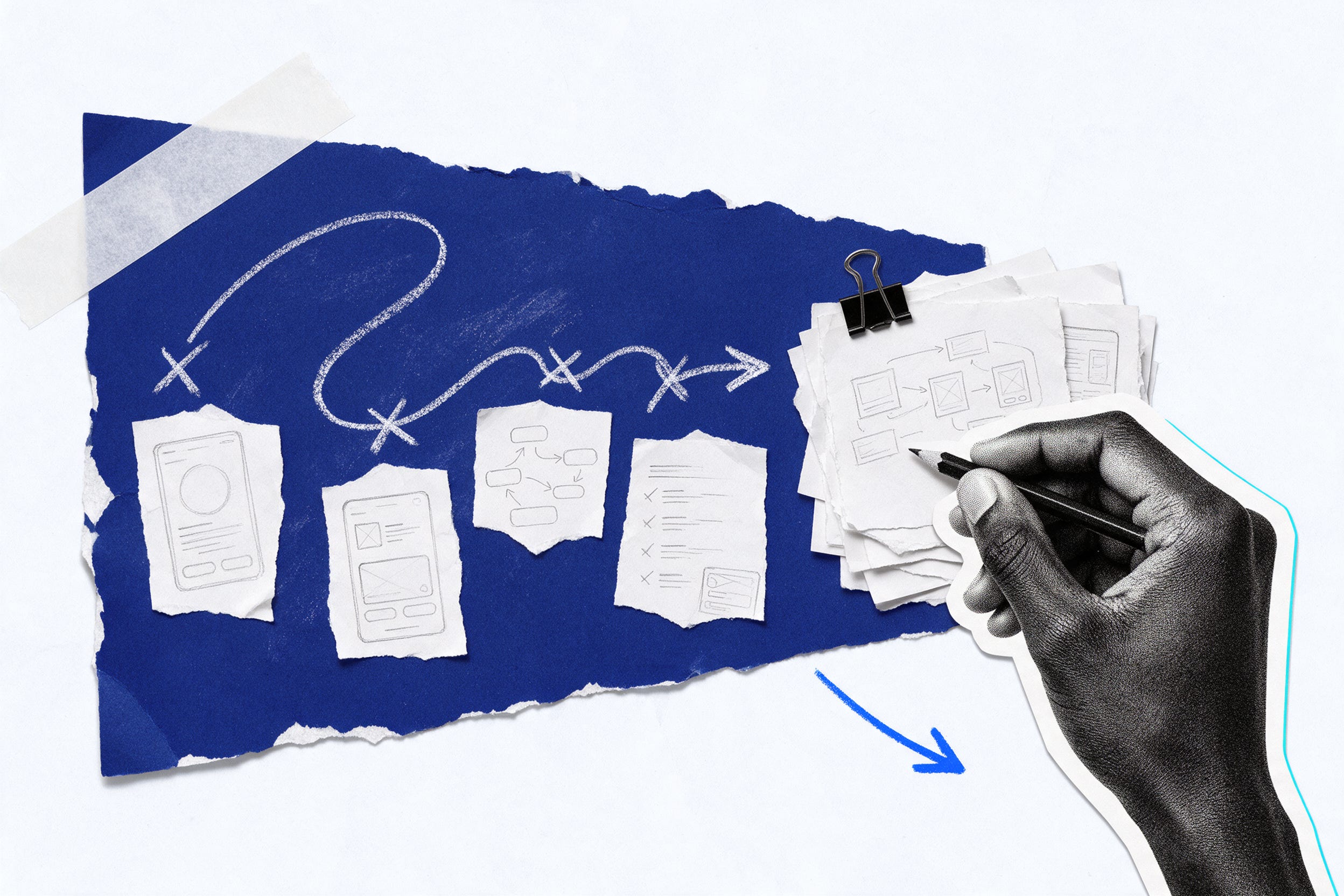
Document the problem you are solving, who the users are, the outcome of your research, the options you had, and why you chose the one you did. Show the wireframes, iterations and final designs.
That is what turns pretty screens into a product design case study.
Do this weekly for three months, and you will have yourself a portfolio and a sharper sense of what good design looks like. Also, you do not need to build a fancy website for your portfolio.
A simple presentation on Behance, Dribbble, or even Notion works, especially when you are just starting out. No hiring manager would care about how cute your portfolio looks if the quality of work in it is awful.
Play 3: Visibility is on the other side of being cringe
“Don’t mistakenly blow up as who you are not.”
On the Field: When you are starting out in your career, you must prioritize visibility because it moves the needle. Visibility makes it easier for people to discover you, understand your value, and decide to hire you.
If you are worried about falling into the slippery slope of aura farming or unintentionally becoming an internet personality, there is a way around that.
The Move: Whenever you share your work, ensure it revolves around what you are learning and your thought process around problem-solving.
It could be explaining a design decision you made, sharing your thoughts about a redesign or product experience, and talking about something new you learned from user research.
If engagement is what you want, then you could share a case study from your project and ask other designers to critique your thought process.
Anything other than this is overkill because remember, the goal is to make it easy and possible for the right person to see your work.
“One random Saturday, someone I coached reached out to me to ask if I was available to work on a digital platform being developed for Edo State. We got on a call on Sunday to align, and by Tuesday, I was on a flight to Edo. Every aspect of that experience changed my perspective on what is possible.”
Play 4: The relationships you built yesterday come in handy today
On the Field: Referrals are the easiest way to find remote job opportunities, and they typically come from the relationships cultivated long before you need a job: former schoolmates, other designers, product managers, developers, mentors, mentees, friends, or even mutuals on social media.
Good designers rarely work alone. There is constant collaboration with people within the realm such as developers, product managers, UX researchers, marketers, and other designers.
The Move: One opportunity can birth another. Someone you worked with on a project might recommend you to someone else who needs your skills on their team. So while you strive to do good work, nurture your relationships too.
Stay in touch with people. Send that ‘happy birthday’ text. Volunteer when you can, don’t hoard knowledge, join design communities, participate in meaningful conversations, and don’t hesitate to reach out to fellow designers to commend their work or ask questions.
There is no telling what rooms your name might get mentioned in.
Play 5: Take the stepping-stone role
On the Field: Every person whose career you admire had a stepping-stone job that got their foot in the door. Factors you cannot control, such as timing, hiring decisions, budget, competition, and visibility, determine if and when you get an international job.
The Move: Don’t turn down the stepping-stone role. It’s alright if you work for a local company, or take on small projects as a freelancer. Your first opportunity to work with engineers and a product manager on a real payment product might just be at a local startup.
The small opportunities are great because they allow you to sharpen your skills, meet people, and do work that you can share.
Don’t take them for granted.
Timeout
The Myth: Exposure is all you need when you are just starting out.
Udo’s Truth: Ask for financial compensation but don't be greedy.
Play 6: Your work ethic must be A1
On the Field: Getting the international job is one thing. Keeping it is another. When you work with an international team, you must understand that your colleagues operate in a completely different time zone, with different expectations around communication and professionalism.
An example is punctuality. If a meeting is scheduled for 10 am, be there at 9:55 am.
.
The Move: For teams working across countries, a delay may feel insignificant to you but it can disrupt someone else’s schedule. Being reliable is a core value for remote teams.
This applies to communication, meeting deadlines and being clear about what you need. If you are waiting on a developer, say that. If you are unsure about a requirement, ask. If you have changed course due to new information from users, share that with your team.
Always remember that your team cannot simply walk over to your desk for a quick chat. So your Figma file, documentation, messages and presentations need to be stellar.
It’s not enough to just show that you can do the work. Make it a priority to show that you are trustworthy when you join that international team.
Final Whistle: Your ambition is not out of reach
Don’t believe the tales about how nearly impossible it is to land a job as a product designer on an international team from Africa.
There will be highs and lows, but you simply have to focus on becoming good enough to do the work, building proof that you can do it, positioning yourself strategically, and building relationships that get you in the right rooms.
So start where you are and build from there. The quality of your work will take you further.